I.
After having a conversation with a friend at lunch today I came to the realization that the human mind is constantly drawn, through thought patterns and innate reasoning, to eternity. In other words, the mind naturally flows towards that which has always been.
When the mind is in a state of undistracted self-awareness, thoughts naturally arise. It senses something beyond itself and asks existential questions: "What was before me?", "Why am I here?", and "What follows death?" It jumps a layer of abstraction above sensory perception, to concepts that are greater than the physical environment it is attached to. The transcendent aspect of the mind reveals the unique distinction it has from the body. This I failed to grasp until today: the surreal abilities the mind possesses.
II.
Consider, for instance, our capacity to comprehend concepts such as nothingness and infinity without ever experiencing them with any of our five senses. The ability to envision them must then be innate; no possible inductive reasoning can deal with such ideas. Seeing the lack of an object should not (by experiential reasoning) lead to the concept of non-existence, but only to the understanding that object is not here. This is a relational property, not an entirely new abstract dimension. Yet the mind creates a connection with that which the body cannot experience.
III.
Parallel to this, the mind holds in itself the entire world.1 It is able to create an infinite inner theater around itself grounded by all it has experienced. The way it manipulates and shapes this knowledge cannot be quantified and appears to be infinite. As an example, you are able to recreate in your mind the entirety of a person (with your limited understanding of them) and have an incalculable number of conversations together, each unique in its own way. The possibilities are endless; we constantly sense, internalize, combine, break apart, and rebuild.
Being made in the image of God, the mind is bound to create, and so, in our own way we partake in the act of creation too.
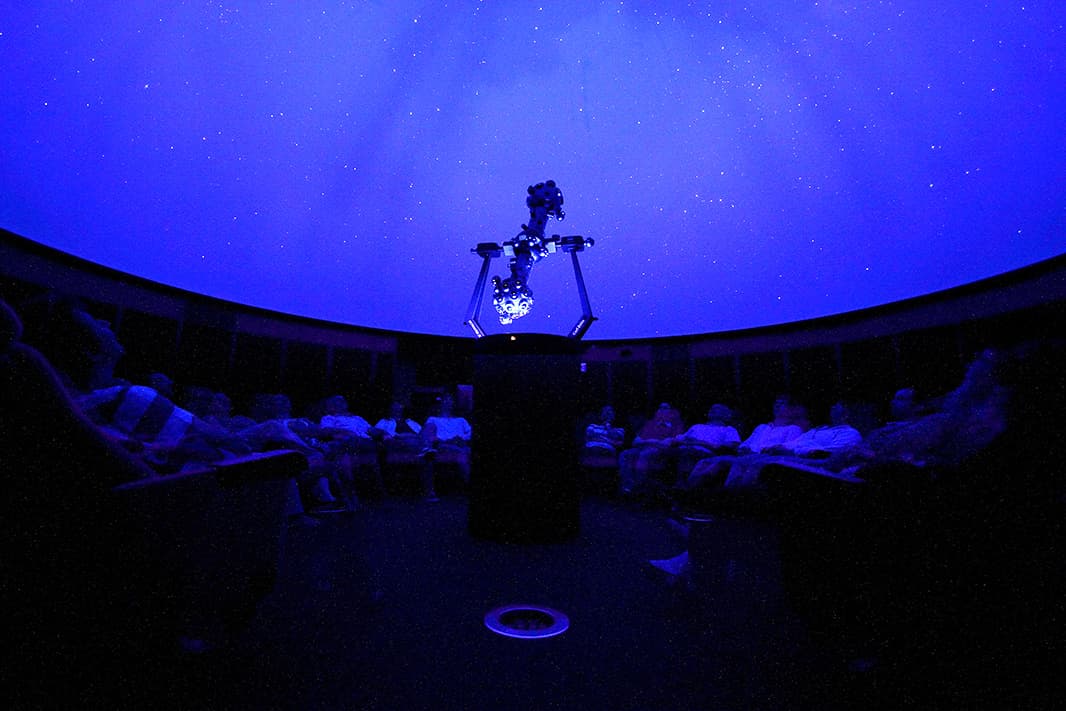 I like to picture this inner creative world as a planetariumcredit
Footnotes
-
The concept of the mind as microcosm, as viewed by St. Maximus the Confessor. ^